What can we learn from football scouts?
With the World Cup approaching, we gladly look at valuable insights from elite sports. At Longtail Search & Interim, everything revolves around recognizing top talent. How do you select the future standouts before their great successes become visible? Recent scientific research into the methodology of football scouting reveals a surprising number of parallels to the business world.

The art of selection before performance is delivered
At Longtail, we value engaging with talent during the early stages of a career. Once an individual achieves success in an executive role, identifying their capability and understanding the underlying factors is straightforward. The true art lies in making that selection before the performances are fully visible. This is precisely the challenge faced by scouts at top football clubs. In 2022, Bergkamp and colleagues investigated how 125 Dutch football scouts identify talent.
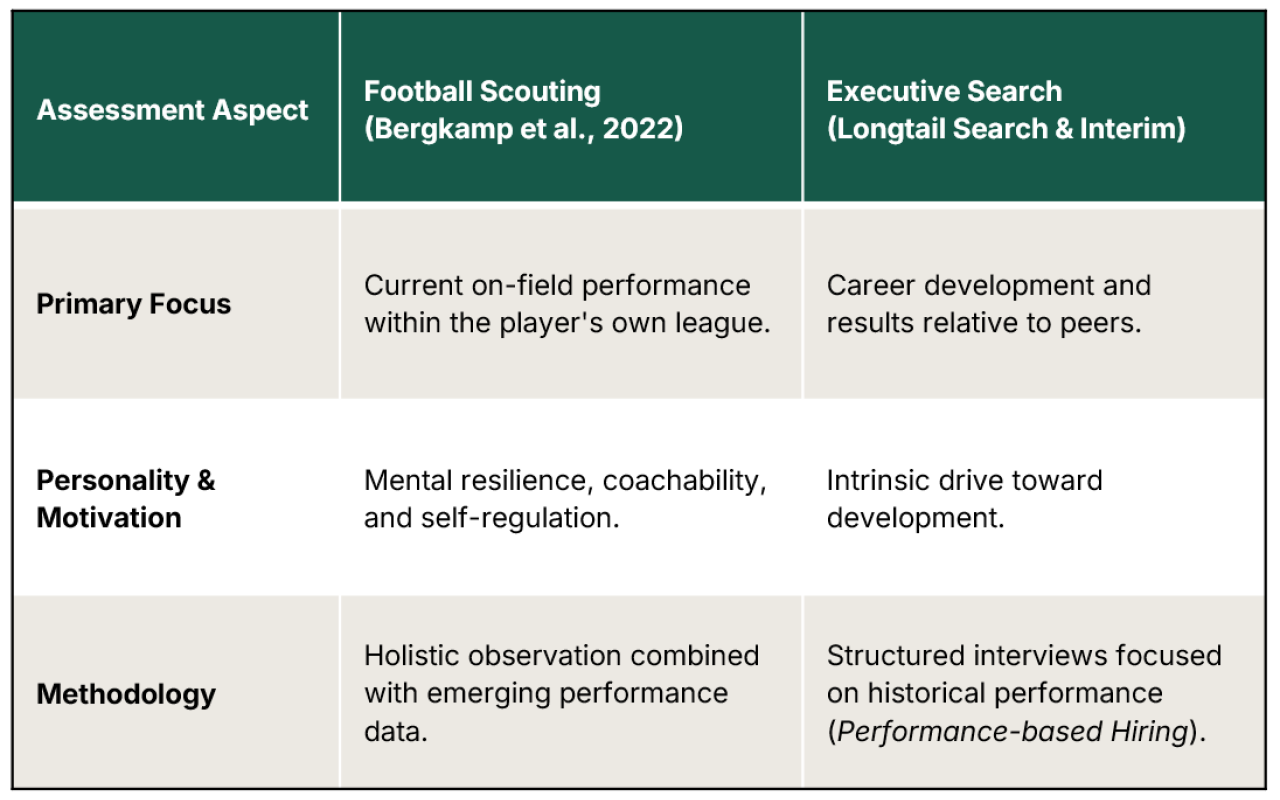
In executive search, we evaluate the early career phase by looking at performance relative to peers: academic achievements, the organization an individual joins, the results achieved, and the subsequent career steps taken. Outpacing colleagues within an environment of driven professionals provides a strong indication of talent. This approach aligns with the principles established by Adler (2021), who asserts that historical performance within a challenging context represents the most reliable predictor of future success. Determining performance and growth relative to peers is essential in this regard. Football scouts recognize this principle; they assess players exclusively in relation to peers occupying the same position.
Personality and motivation as distinctive factors
The top talents we see succeeding in prominent positions later in life possess a diverse set of competencies rather than a fixed profile. A striking commonality, however, is that they are exceptionally driven by development. They constantly evaluate how to accelerate their growth and remain focused on this goal in a highly consistent manner.
The research by Bergkamp and colleagues reflects this finding directly. Drive and intrinsic motivation were frequently cited by scouts as relevant predictors, and a good number of scouts even designated this as the single most critical factor. Scouts in football and executive search consultants arrive at the exact same conclusion: the ultimate question is whether an individual is driven to grow from within.

Structured assessment versus intuitive decision-making
This area presents one of the most compelling tensions. The surveyed scouts indicated that they operate structured processes: 74% evaluate players against identical criteria, and 73% know beforehand which characteristics they intend to assess. Yet, the majority of scouts base their final judgment on a holistic impression. Only 41% combine the individually scored characteristics through a fixed decision rule. The remainder rely on intuition—an approach the researchers term holistic, and one that scientific literature identifies as a suboptimal strategy due to its tendency to produce inconsistent predictions.
We observe an identical pattern within the corporate sector. Many selection decisions are based on an initial impression, whereas scientific consensus has been clear for decades: structured, criteria-based assessments yield far more reliable predictions (performance-based hiring).
The overview illustrates how this dynamic compares across both worlds.
Early selection: risk or opportunity?
The largest group of scouts in the study evaluates players under the age of twelve, yet those same scouts indicate that reliable predictions regarding professional success can only be made from an average age of 13.6 years. Consequently, they conduct assessments at an age where, by their own admission, making dependable statements remains difficult.
We recognize this dilemma within our own field. Identifying talent early is highly valuable, yet characteristics visible at a young age always require context. They remain subject to change. For this reason, we focus primarily on the direction an individual is moving and the velocity of that movement, rather than exclusively looking at their current status.
Conclusion
Football scouts and executive search professionals share the same fundamental challenge: how to recognize an individual with the potential to excel before that potential has been fully proven. The similarities are striking. In both domains, we see an emphasis on psychological traits, the vital role of intrinsic motivation, and the tension between intuition and structure. The primary distinction lies in the willingness to implement that structure consistently into the final judgment. On that front, significant progress can be achieved in both worlds.

Sources:
Adler, L. (2021). Hire With Your Head: Using Performance-Based Hiring to Hire Great People. John Wiley & Sons.
Bergkamp, T.L.G., Frencken, W.G.P., Niessen, A.S.M., Meijer, R.R., & Den Hartigh, R.J.R. (2022). How soccer scouts identify talented players. European Journal of Sport Science, 22(7), 994–1004.
Interested in exploring how to apply this strategy within your organization?
Get in touch, we’d be happy to think along with you.